Showing posts with label Burgundy. Show all posts

Sunday, 17 June 2018

Montbéliard 2


What a quiet night! 
A clear blue sky greeted us this morning. We had breakfast and thought that an early morning visit to centre-ville before the day heats up was a good idea. 
We were stopping just over l’Allan River giving us good access to the town. The first things we noticed was the attention giving to the parks and flowers around the town, and, the large amount of work being undertaken to make the place much more people friendly. 


The dominating feature of the town is the château. The Château de Montbéliard, also known as the Château des ducs de Württemberg is a fortress located on an outcropping rock that overlooks the town. It was in the Württemberg family from the 14th century until the French Revolution when it became the property of the state. From that time until 1933 it was used as a military garrisons. After this it became a local museum. 


The Dukes were responsible for the introduction of Lutheranism into the town in the 16th century. The architecture from those times is very much in evidence today. Later,  in its history,  the French made a great effort to bring Catholicism to the area, and so, a grand church, Église St Mainboeuf, directly above the Lutheran church, Temple St Georges, was built! 


Around the streets interesting buildings caught our attention, with a mix of styles - and some very practical solutions to problems that might arise. 

The house in the photo at the bottom left has an interesting spouting!


The little shop with the yellow frontage is where we bought our bread, not that interesting I hear you say, but here was the first black baguette we had seen. The lovely lady in the shop explained that it was made with cacoa and that it aided digestion. 

The World Cup football theme was running through many shops and streets, but the headlines this morning seemed to be suggesting that Les Bleus were a little lucky in yesterday’s game against Australia! Hmmmm!

Some other aspects caught our attention around the town!


We returned to the van for lunch and to give our feet a little rest. 


A little way over yonder the locals were celebrating all things American - baseball, music, bands,  boot scooting, cheer leaders, roadster bikes and American fries and hamburgers! The festival was well organised with a program that ran through most of the day. Interesting to see the clientele attending!


All in all, a very enjoyably full day. 

Saturday, 16 June 2018

Montbéliard

Today we followed the course of  le Doubs  further upstream this morning to Montbéliard. We can see why this area is particularly popular with cyclists with a cycle track running the full extent of the river. In fact, the guy in the tourist office said, you can cycle right from the Baltic through to the centre of France on the Eurovelo 6 cycle track. 

A varied day again! A visit to the supermarket, followed by a wander around the Saturday morning market in Montbéliard,  before settling down for the afternoon next to the marina on le Doubs. 


This afternoon we visited the  beautiful le parc du Prés la Rose, just a little way along the river, to cool off and to enjoy the local festivities in the park. 


We noticed a lot of children, with their parents, dressed in what looked like tradition Dutch clothing. It turned out that they were children from a local Lutherian school performing very traditional songs sung in the language of the region, “old French”, as it was explained to us. 
This part Franche-Comté was once of the territory of the Dukes of  Württemberg, German dukes, who introduced the  Lutherian church to Montbéliard. 


Following this presentation was a performance by a group of men with their alpenhorns. An appreciative crowd had gathered to listen to the music, perhaps many being proud parents. 


Moules en vin (mussels in white wine) for supper tonight! Delicious!

Friday, 15 June 2018

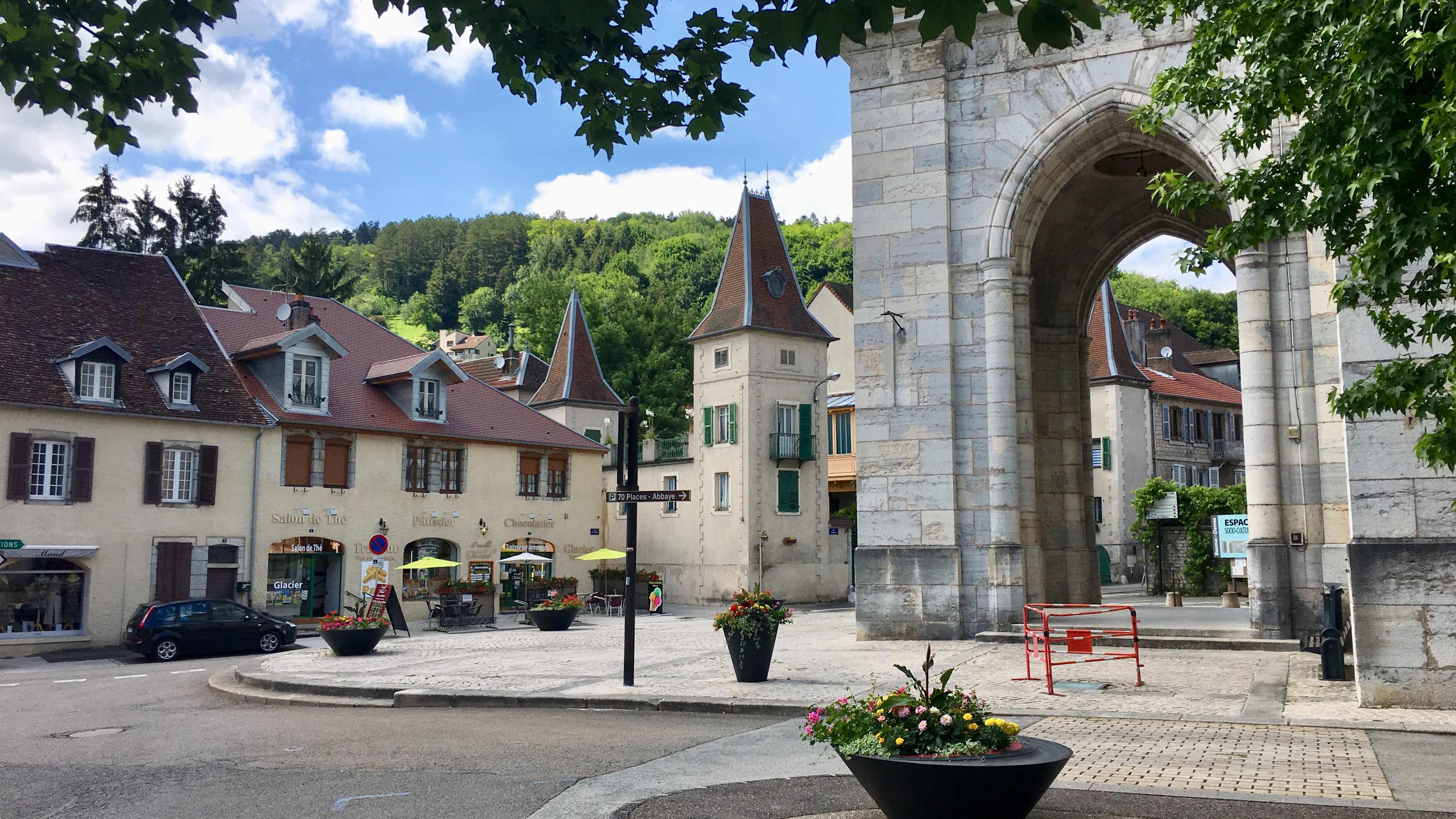
Baume-les-Dames


From the village of Laissey we followed le Doubs river to Baume-les-Dames, passing some stunning scenery on the way.  At Le Saut de Gamache we caught a glimpse of  le Doubs winding its way through the mountains, villages and farmland of this region. 


Baume-les-Dames, a town of nearly 6000 residents, takes its name from the many surrounding caves in the valley of  le Doubs and the nuns of the abbey founded here in the 7th century. It was the abbey that gave rise to the city. 


The nuns of the abbey were exclusively from noble families, and thus became very wealthy over time, enabling it to build the current abbey church. This sumptuous church was closed after only 60 years due to the French Revolution. Today it houses a most interesting art exhibition. 


We were fascinated last evening when no fewer than 5 trains carrying at least 400 Peugeot cars each passed through the village of Laissey. The birth place of Peugeot is just a few km up the river where there is still a large production plant. 


Hilton smelling the flowers on a warmish day!

The beautiful Plain tree has been pruned and tendered over the years, but it was interesting  to see that nature had  still imposed itself on the parking sign placement! 

 
And, this is what we found in a tourist document that was outlining some of the cultural idiosyncrasies of Baume-les-Dames! One local treat we weren’t tempted to experience!


Sunday, 10 June 2018

Delightful Dijon

Sunday, a big city day, if possible!  So Dijon was given the royal treatment- well, a good look around might be more to the point. 
To get a premium parking place close to centre ville we left Velars-sur-Ouche before 7 am, arriving in Dijon shortly after 7.45 am. We were able to get a spot just behind The Palais de Ducs (The Dukes Palace) right at the centre of the main area of the city. Here we had breakfast before venturing out to explore Dijon. 

In Celtic times, Dijon held a strategic position on the tin merchants’ route from Britain to the Adriatic. It became the capital for the dukes of Burgundy around 1000 AD, and in the fourteenth and fifteenth centuries, under the auspices of the dukes, Dijon flourished. The dukes used their tremendous wealth and power – especially their control of Flanders, the dominant manufacturing region of the age – to make this one of the greatest centres of art, learning and science in Europe. It lost its capital status on incorporation into the kingdom of France in 1477. 

The Palais du Ducs and Place de Liberation. 

Place de Liberation

Place de Liberation

Dijon is also famous for its mustard and pain d’épice (gingerbread), a reminder of the town’s position on the spice route. Gingerbread is available all over the city. 


Today, much of that wealth is on display by what still remains from those times. Many of the old streets still retain their character with timber frames houses alongside more palacial sandstone, wealthy, merchant houses. 


The Palais de Ducs now is the home of the Dijon Museum of Art. It houses some outstanding works from Flemish, Italian and French artist of the Middle Ages and the Renaissance. The first floor is dominated by the giant, almost decadent, mausoleums of two of the dukes and a duchess. 


A cute little story of the sculptured owl on the 13th century Notre-Dame Church. It is said that if you rub it with your left hand then this will bring you luck! It didn’t work today when looking for LPG at the end of the day, and, people have been doing this for over 600 years!


An intesting expo in the foreground of the  The Palais de Ducs promoting women’s fashions and health care. Fashion parades for the latest Italian and French designers were part of this outdoor expo. 


The visit to Dijon was well worth it. We spent many hours exploring the place and found it a great city to while-away a sunny Sunday. 


We later drove to the canal marina at Maxily-sur-Saône for the later part of the afternoon and overnight.